
Something’s breaking in your team.
Here’s how to fix it before it
breaks your company
Between 11 and 30+ employees, almost every startup hits the same wall: decisions slow down, culture gets fuzzy, and you’re suddenly spending more time managing people than building product.
You don’t need a full HR department.
You need the right systems.

You’re not bad at managing people. You just never got the systems.
Most founders ask themselves some version of these questions at some point.
These aren’t signs you’re doing it wrong. They’re signs you’ve hit the stage where the informal stuff stops working. Not corporate HR. Not a 200-page handbook. Just the systems that make your team work without you holding it all together.
That’s what I help with.
▶︎ When should I hire my first HR person?
▶︎ Should I go fractional or full-time?
▶︎ What People processes do I actually need before Series A?
▶︎ How do I handle a performance issue without a proper HR process?
▶︎ How do I keep the culture intact when we’re hiring 10 people in three months?
▶︎ And how do I stop being the one who has to make every people decision?
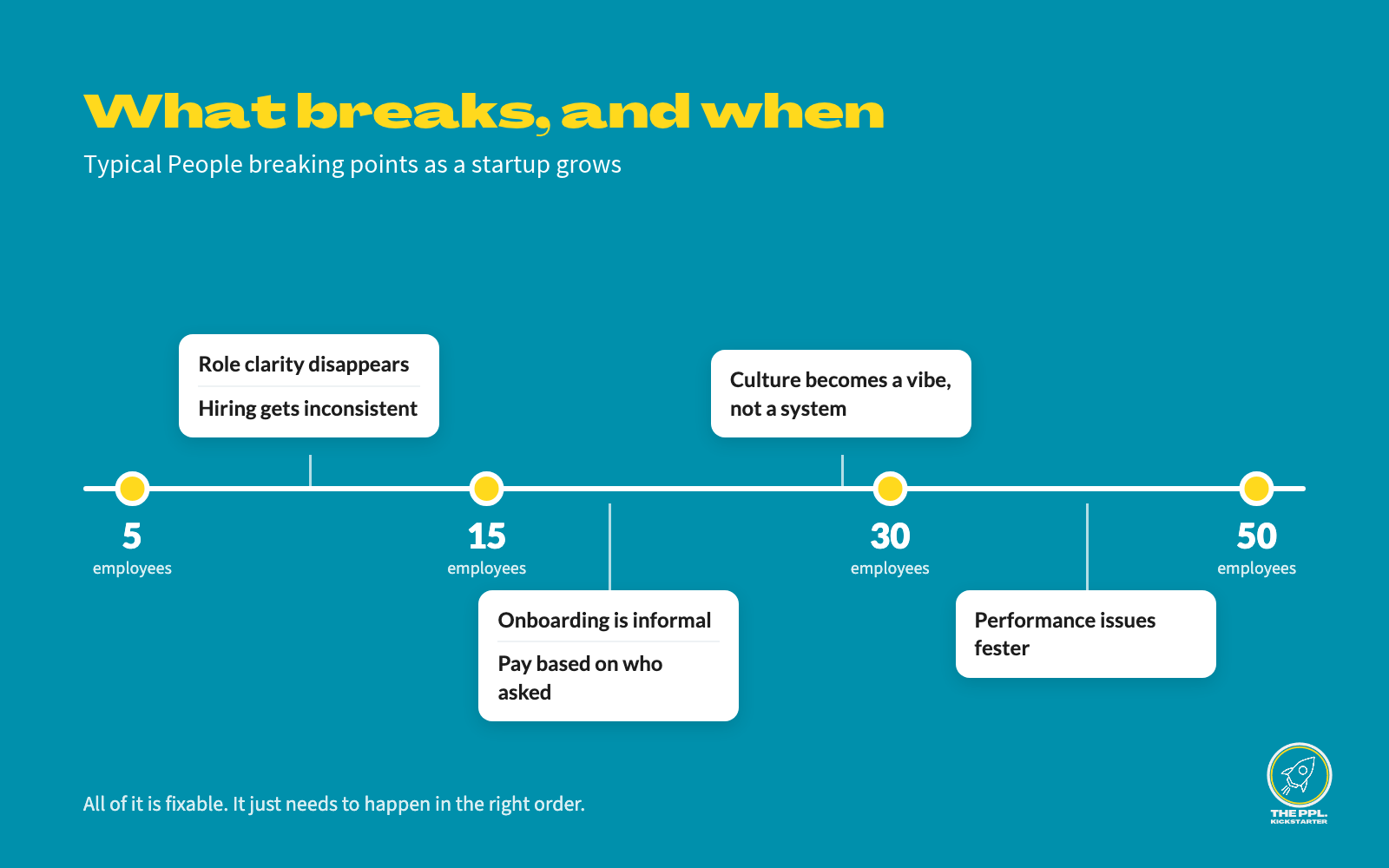
What breaks in a startup between 15 and 30 employees?
Almost everything people-related, in my experience. Here’s what I see most often:
Role clarity disappears. At 10 people everyone just knows what they’re doing. At 25, nobody does, and nobody wants to be the one to say it.
Hiring gets inconsistent. Every hire is a negotiation. Pay is based on who asked for what, not on any actual logic. You’ve created pay inequities you didn’t intend, and you’re dreading the day someone asks what their colleague earns.
Onboarding is informal at best. New people take three months to figure out what’s expected of them.
Culture becomes a vibe, not a system. You know what it was. You’re not sure it still is.
Performance issues fester. You know someone isn’t working out, but there’s no process and you don’t want to get it wrong.
The good news: all of this is fixable.
It just needs to be done in the right order.
Fractional Head of People or full-time hire: which one when?
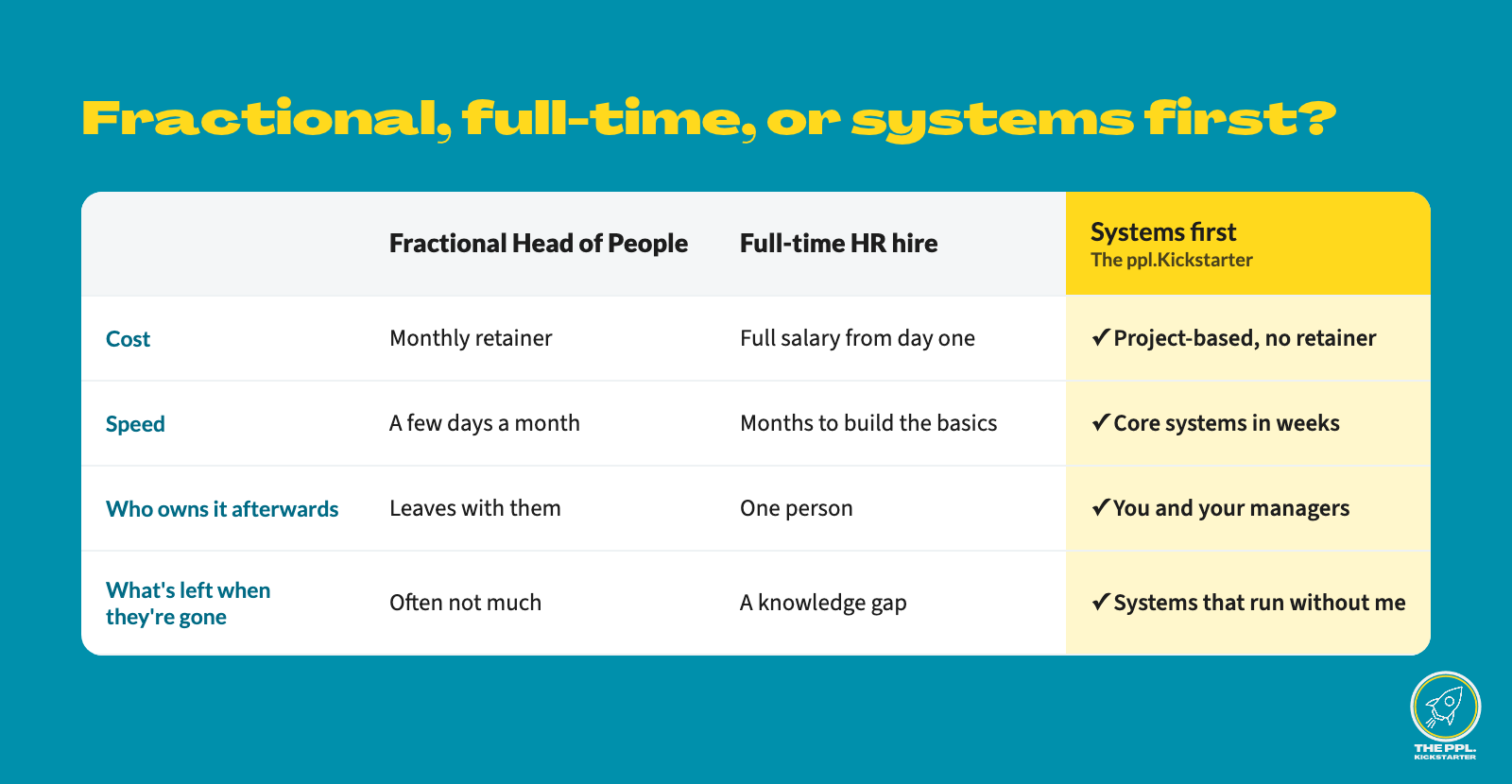
My take: most startups ask this question too early. Before you add a person, you need the systems that person would run.
A fractional Head of People gives you someone for a few days a month. Useful, but when they leave, the knowledge often leaves with them, and you’re still the bottleneck in between. A full-time hire before 30–50 people is usually expensive, and they spend their first months building the basics anyway.
What works better below 50 people: get the core systems in place first (comp logic, hiring process, onboarding, role clarity, a way to handle performance) and make them owned by you and your managers. Bring in expert support for the specific pieces, then step back.
That’s how I work: I build it with you, hand it over, and you don’t need me in the room for it to run.
When you do hire your first People person, they walk into a working setup instead of a blank page.
The compensation questions I get from founders most.
Compensation is one of the most avoided conversations in early-stage startups, and one of the most expensive to get wrong. Here’s what I work through with founders regularly:
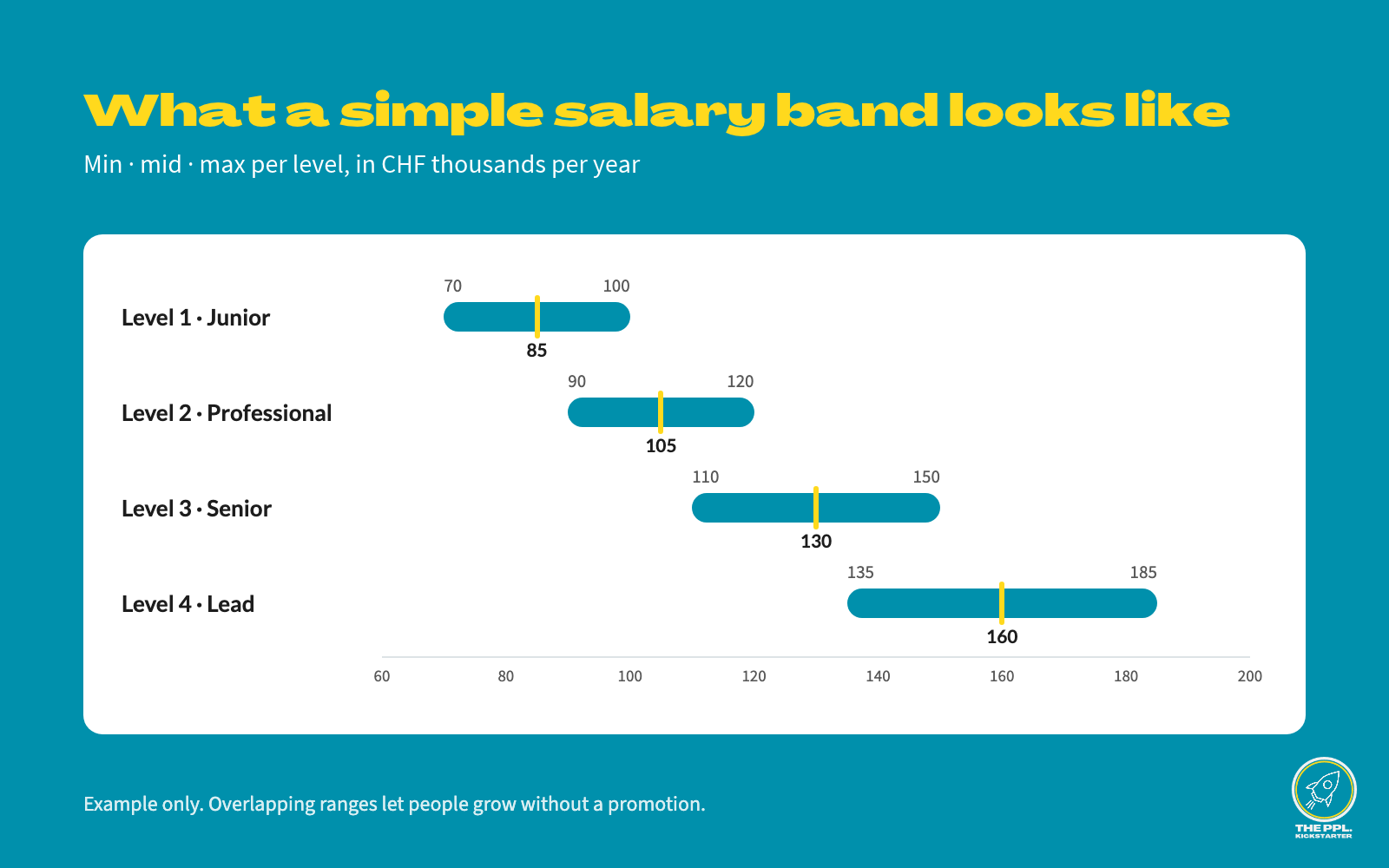
How do I build salary bands for a 20-person startup without a comp team?
What’s a fair pay model when we can’t match big-company salaries?
How do I fix pay inequities we created by negotiating every hire individually?
Do I need a pay philosophy, and what actually goes in it?
How do I explain pay decisions to my team without it backfiring?
Salary vs equity: how do I decide per hire?
And when should we introduce a formal compensation model at all?
If you have employees in the EU, or hire from there, the EU pay transparency directive matters to you too, including salary ranges in job ads. Swiss companies aren’t directly bound by it, but it’s quickly becoming the expectation candidates bring with them. Getting ahead of this now is much easier than retrofitting it later.
If any of these feel urgent, let’s talk.
-

"Our goal was a comprehensive compensation framework tailored to our small but growing organization, and we achieved it. We now have a long-term, sustainable model that guides hiring decisions and internal discussions about pay and career levels. Carolin was well prepared for every session, brought practical tools, and truly listened to our needs. She had answers to all our questions. I can only recommend working with Carolin!"
Maria Ufnal, HR Generalist @Exnaton
Where to start, depending on where you are.
No-regret guarantee: If the Full Diagnostic or your first Fix session doesn’t give you at least 3 concrete actions you can start working on yourself, you get your money back. No forms, no discussion.
FREE:
Chaos Check
A 5-minute diagnostic that tells you exactly where your team is at risk right now. Results straight to your inbox.
From CHF 37:
DIY toolkits
Templates, action plans, and the Culture Canvas to fix the most common team challenges yourself, at your own pace.
From CHF 3’500: Work with me directly
Module-based advisory: hiring, compensation, culture, onboarding, performance, leadership, or org structure. Book a call and we’ll figure out where to start.
CHF 1’500 (Fixed): Full Diagnostic + Action Plan
One-time deep dive across 5 dimensions. You leave with a prioritised, actionable plan. No retainer required.
What People processes do I need before Series A?
One of the most common questions I get, and investors are increasingly asking founders about it too. Here’s the short version:
A documented compensation structure (even a simple one)
A hiring process that isn’t just “the founder interviews everyone”
A clear onboarding journey for the first 90 days
Basic role clarity across the team
A way to handle performance that doesn’t need legal advice every time
You don’t need perfection. You need evidence that you’ve thought about it and built something intentional.
Start with a clear picture. Then fix it together.
The Chaos Check or the full diagnostic shows you where your team is at risk. From there, I work with you directly: 1:1 advisory, culture workshops, comp design, and role clarity.
Same pattern recognition I’ve built across 30+ startups, applied to your team.
And for anything beyond People & Culture, I connect you with vetted specialists from my partner network in legal, finance, recruiting, and tech, for example:




Built on real teams, not theory.
20+
Diagnostics
30+ Teams coached
75+ Startups supported
20+
Years
20+ ppl.intelligence diagnostics, each with a custom action plan
30+ teams coached hands-on, 75+ startups supported across mentoring, coaching, speaking, 1:1 and group formats
First coach accredited by Innosuisse (2024) for HR in the scaleup context, a category I helped define
LP and angel investor in early-stage tech, so I know what investors look for in your team
20+ years across HR, org development, compensation, M&A, and culture
Trusted by founders, accelerators and VCs (below)
As of 2026






-
"The Culture System and Culture Cornerstones gave us something we didn't have before: a clear, practical way to talk about our culture, hold each other accountable, and onboard new people into who we are, not just what we do."
Armin Koller, CEO @KEMARO
Questions I get from founders
-
Most startups don’t need a dedicated People hire until 30–50 employees, depending on hiring pace. Before that, putting the core systems in place and owning them yourselves gives you more for every CHF, and makes your first People hire far more effective when it comes.
-
A fractional Head of People works in your company a few days a month, on an ongoing basis. I work project-based: I build the systems with you and hand them over, so you and your managers run them yourselves. No ongoing dependency.
-
Translate each value into 2–3 concrete behaviours, build them into hiring and feedback, and give them rituals. Values on a wall change nothing; values in decisions change everything.
-
Systematise what made your culture good before you scale it: values that translate into behaviour, onboarding that transmits culture deliberately, and managers who know what good looks like.
-
Clear decision rights, simple processes your managers can own, and templates so nobody has to reinvent the wheel. It’s usually the first thing we fix.
-
Yes. Zurich-based, working with startups across Europe and internationally.
-
Take the Chaos Check. Five minutes, immediate results, and it tells you what to focus on first.
Not sure where you fit? Let’s figure it out.
Book a 30-minute call or DM me on LinkedIn, and we’ll work out what makes sense for where your company is right now.